
Beverly City Directory Collections
The strongest shelf begins with the Beverly Public Library and its local-history holdings. NOBLE metadata identifies 76 Beverly City Directory and North Shore map volumes, contributed by the Beverly Public Library and published by Crowley & Lunt. The run is described as 1886 through 1985, with gaps. A State Library inventory reaches still earlier for some directory years and adds house guides and voting lists. Treat each inventory as a holdings list, not a promise that every item is online or available on a particular day.
| Collection | Years | Where Held | Access |
|---|---|---|---|
| Beverly City Directory and North Shore map set | 1886-1985, with gaps | Beverly Public Library / NOBLE | Collection metadata and digitized items |
| Observed digitized directories | 1886; 1893; selected years 1904-1985 | NOBLE and Internet Archive | Check individual volume availability |
| State Library directory holdings | 1873-1918, selected runs | Massachusetts State Library | Consult the official holdings list |
| House guides and voting lists | 1905-1947; selected later years | Massachusetts State Library | Complementary, not continuous coverage |
Beverly Public Library Local History & Genealogy describes the Beverly Room’s directory, street-list, map, yearbook, scrapbook, pamphlet, and town-document resources.
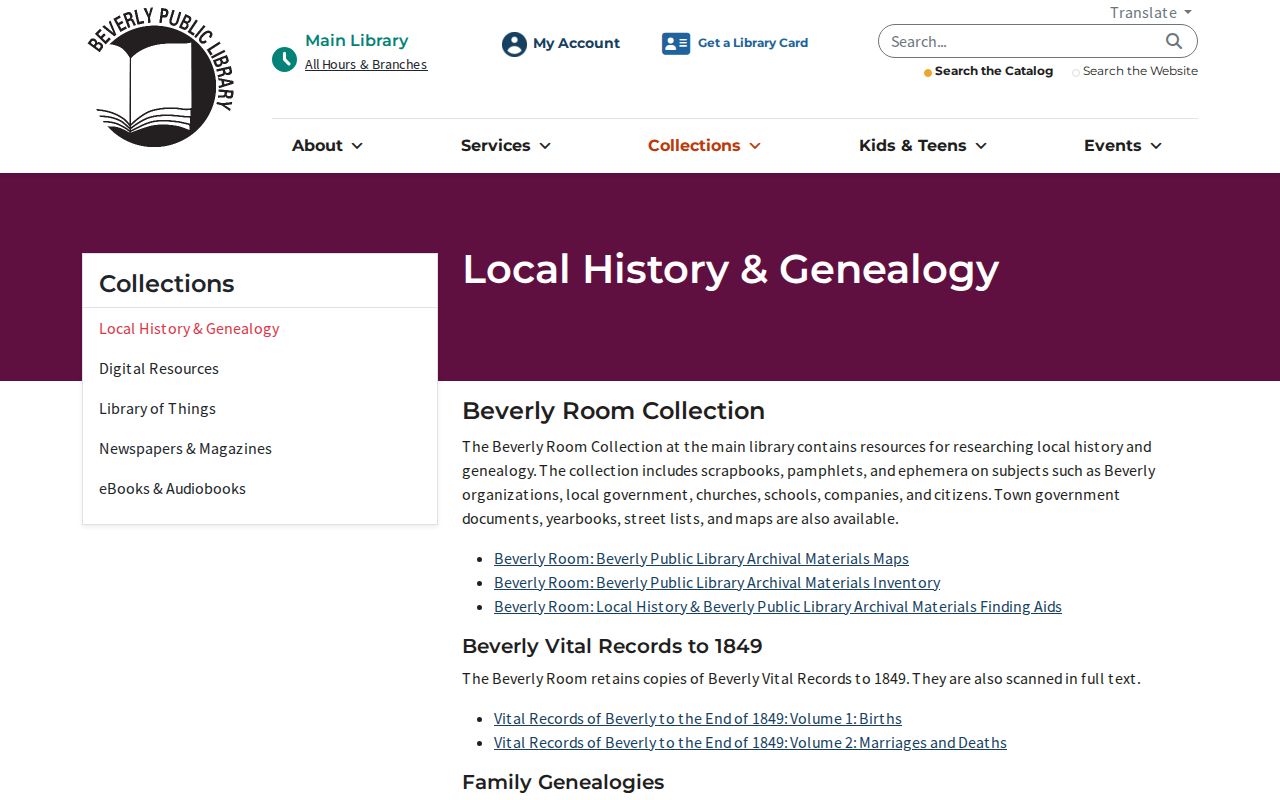
Those related materials help test whether a directory address reflects a household, an institution, or a changed street name.
Beverly Room Directory Holdings
The Beverly Room is useful when a name search needs context. Its documented materials include local organizations, churches, schools, companies, citizens, annual reports, photographs, cemetery resources, street lists, maps, and Beverly vital records through 1849. A directory can point to a year and address; the surrounding collections can help distinguish a family-history lead from an unsupported assumption.
Historic Beverly’s Research Library offers another local route at Cabot House, 117 Cabot Street. Its published collection description includes directories, maps, newspapers, photographs, local and regional books, diaries, letters, ledgers, maritime records, and genealogy material. Published hours, service rates, and access conditions can change, so confirm them before travel or ordering a search. The research service is listed with an hourly minimum, while collection and archive access have their own stated conditions.
The Massachusetts State Library’s genealogical resources guide is a useful second catalog check when a Beverly volume is missing from a local result.
Comparing catalogs first prevents a gap in one collection from being mistaken for a year when no directory existed.
Beverly Digital Directory Collections
Beverly Digital Heritage brings together city directories, Beverly Lists of Persons, yearbooks, annual reports, oral histories, postcards, photographs, and other local material. Its collection metadata makes a good discovery tool, but the original scan remains the source to read and cite. Record the item title, volume year, image or page, and whether the text was OCR, a scan, or staff-supplied information.
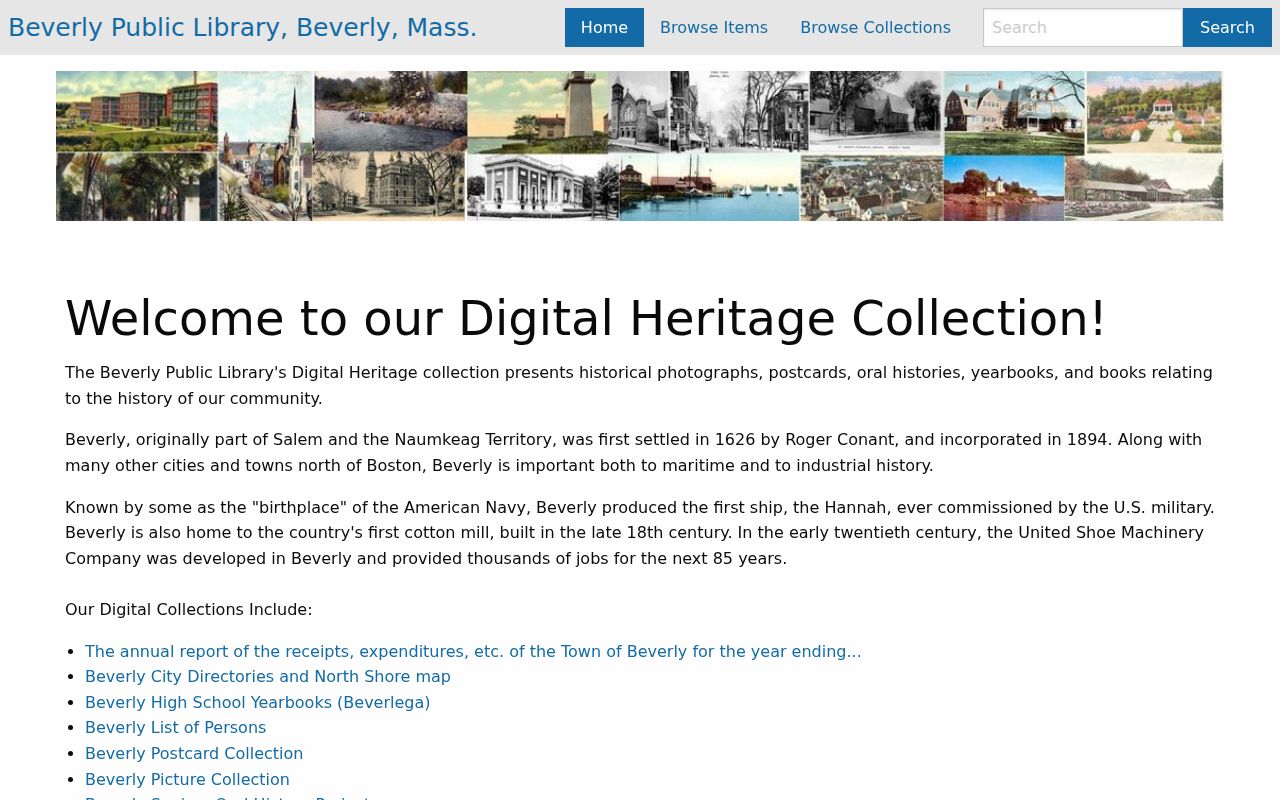
A photo or yearbook found beside a directory item can supply place and date context without proving a person’s current connection to an address.
The separate Beverly city-directory item set identifies the 76-volume run and the Beverly Public Library and Crowley & Lunt connection.
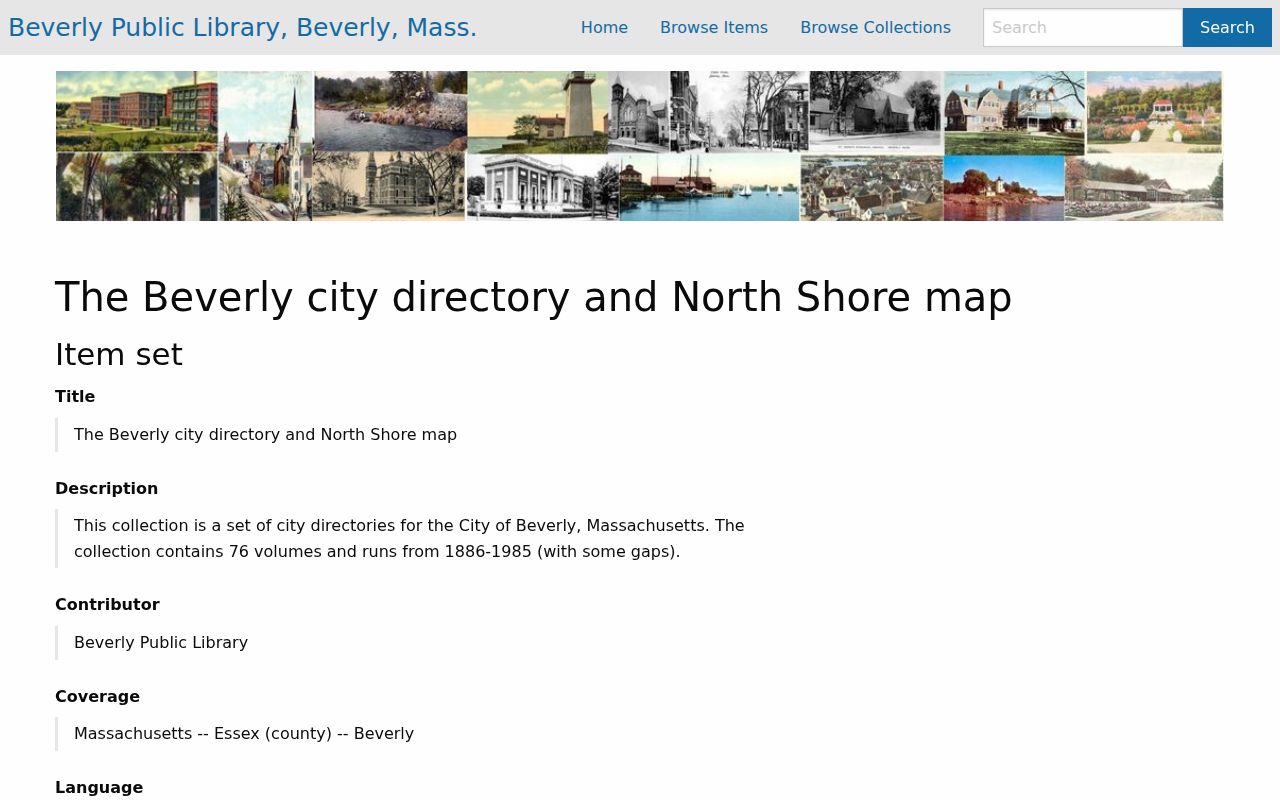
Observed online years include 1886 and 1893; selected years from 1904-1927; 1929-1937; 1939-1944; 1946-1953; 1955-1970; and 1974, 1976, 1979, 1981, 1983, and 1985. The inspected Internet Archive subject search also returned 76 records. These are grouped observations, not a claim of uninterrupted annual publication or digitization.
Reading Beverly City Directory Entries
A 1981 OCR sample demonstrates the practical reading order. Entries present the surname in capitals, then a given name with possible middle initial or suffix. Parentheses can carry a spouse or household notation. A short occupation or business affiliation may follow, along with a street address and telephone field. These fields identify the form of the entry, not a guaranteed biography. The directory is a dated snapshot and can carry omissions, stale telephone numbers, abbreviations, and household conventions.
| Name line | Surname, given name, middle initial, and suffix where printed. |
|---|---|
| Household notation | Parenthetical spouse or relationship information when the entry includes it. |
| Affiliation | A short occupation, employer, or business line, often abbreviated. |
| Street address | The year-specific location, which may use a shortened street form. |
| Telephone field | Historical publication data; avoid republishing a full number when a citation is enough. |
The same OCR shows an (H) marker. Its key was not verified in the inspected material, so preserve the symbol and do not invent an expansion.
Beverly Directory Terms
Read the front matter before transcribing an entry. The abbreviation list, publisher notes, and section arrangement can explain a shortened occupation or a marker that would otherwise be guessed at.
- Criss-cross directory
- An address-ordered section that helps move from a street and number back to listed names. Not every Beverly volume has the same arrangement.
- Householder index
- A list organized around a household or address rather than a complete roster of everyone living there.
- Abbreviation key
- The volume’s explanation of shortened words and symbols. Photograph or cite it with the entry.
- Directory listing
- A year-specific publication record. It does not establish title, present residence, or every household member.
Trace Beverly Directory Households
A sound household trail combines the entry’s date with another source of the same era. Keep the exact spelling and address form as printed, then maintain a separate normalized search form. Street suffixes, parcel splits, number changes, and postal labels can all disrupt a simple name search. The more reliable comparison is between source-dated relationships: listed in a directory, shown in a street list, recorded as a grantor or grantee, or assessed as an owner.
- Find the earliest or best-known directory appearance and record the volume year, page, spelling, address, and household notation.
- Search nearby available volumes forward and backward. Note moves, an added initial, a changed surname form, or a disappearance.
- Use the address-oriented portion when it exists to see whether the same number has another listed household. Do not treat a shared number as proof of kinship.
- Pair a directory year with the nearest available federal census year. The census can test household composition, while the directory narrows the years between census releases.
- Use a dated obituary, cemetery record, yearbook, deed, or newspaper notice only as corroboration, then retain each source’s date and role in the research log.
For a house-centered trail, the Previous Residents record path combines directories with deeds, maps, and assessor context while keeping owners separate from listed occupants.
Beverly Directory Timeline
Beverly’s documentary geography changes around the books. Boundary work with Salem and Wenham appears by 1679. The city later received land annexed from Salem in 1753, transferred land to Danvers in 1857, and incorporated as a city in 1894. Older records can therefore use a place description that is not identical to today’s municipal boundary.
- 1873-1918: the State Library lists scattered Beverly directory holdings, including early years before the NOBLE run.
- 1886-1985: NOBLE describes 76 Beverly City Directory and North Shore map volumes, with gaps.
- 1905-1947 and selected later years: house guides offer a related address-focused source.
- 1980 and 1989: the State Library holdings list includes Beverly voting lists for those selected years.
The dates mark collection coverage, not a continuous annual run. Match the place name, street form, and municipal history to the record year before joining results.
Keep the collection year beside every Beverly city directory result.
Beverly Maps and Address Changes
Sanborn maps offer a physical check on a directory address. The State Library lists Beverly editions for 1886, 1891, 1896, 1901, 1907, a 1907 map corrected through 1950, 1958, 1964, and 1970. The Library of Congress hosts the public-domain 1958 Beverly set. These sheets can show building footprint, construction clues, use labels, streets, and nearby landmarks. A map label describes the place, not the identity of a person associated with it.
The Beverly historic newspaper archive supplies digitized Beverly Citizen, Beverly Evening Times, and Saturday Morning Citizen issues from 1850 through 1935.
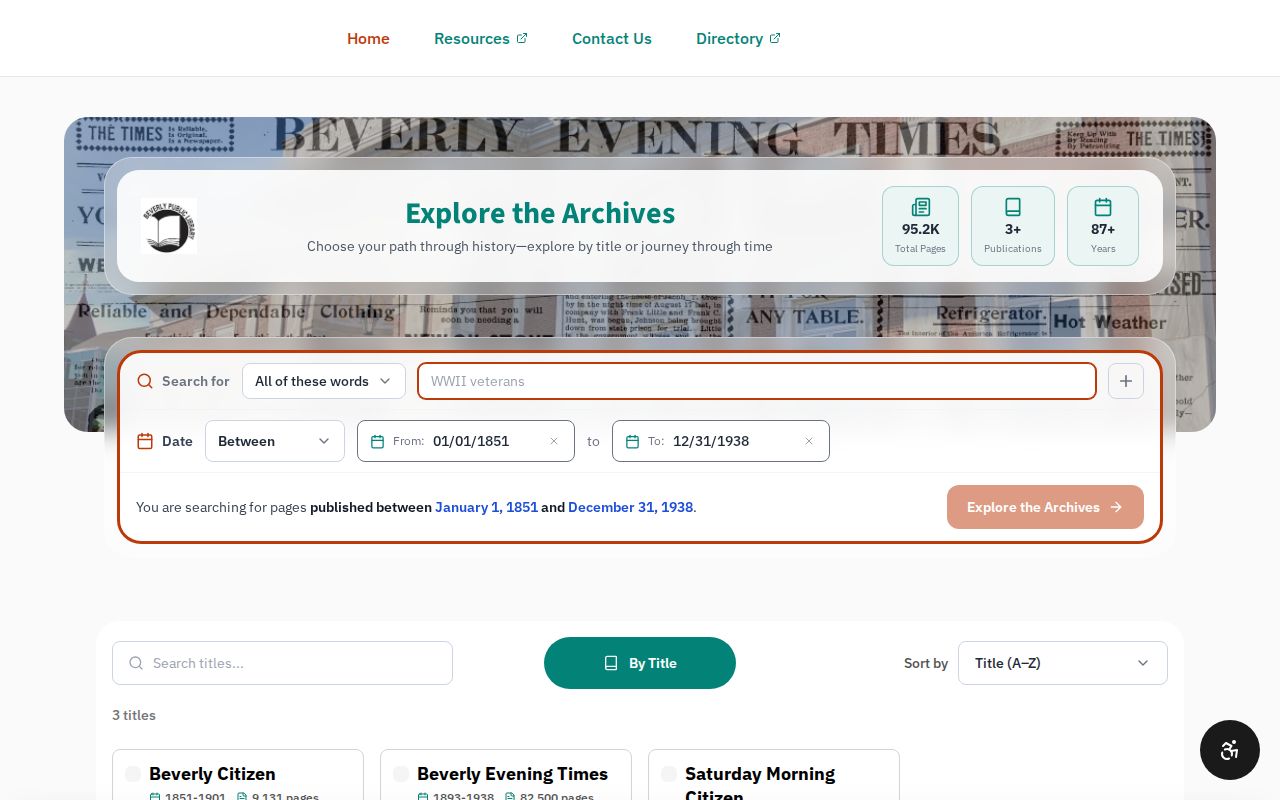
Search a directory surname with a street, spouse, organization, or date, then preserve the newspaper title, page, and issue date. A notice can support a research question, but it does not replace a deed, census, or clerk record.
Beverly Historical Access Limits
Library access is not always remote or permanent. Some digital resources have location, card, or appointment limits, and Beverly Library Trustees recorded database losses in June 2025 after changes in funding. Confirm current access with the library instead of relying on an older collection description. Microfilm extends some local newspaper coverage beyond the digitized archive, but gaps remain.
Historic Beverly publishes research-library hours of Wednesday, Friday, and Saturday from 9:30 to 4:00, plus Thursday from noon to 8:00, with appointments recommended. It says online requests are acknowledged within two business days and most are completed within two weeks. The listed nonmember research minimum is one hour at $25, while in-person collection access is listed at $10 for up to two hours, with stated exceptions. Those are published access details, not a promise of immediate service or access to every fragile item. Confirm the current fee, hours, condition restrictions, and scope before committing a research question.
A source gap is meaningful. The NOBLE run has gaps, selected volumes may be unavailable, and a missing name can reflect an omission, a changed spelling, a different household convention, or a missing year. Note the search year and collection rather than treating no result as proof that a person was absent from Beverly.
When an online volume or a City Census street-list edition is not available, ask the custodian for the specific year, street, and record type. Massachusetts public-records requests are governed by M.G.L. c.66 §10 and M.G.L. c.4 §7 cl.26. A focused request can ask whether a historical edition exists, how it may be inspected, and whether protected information has been suppressed. Keep findings modest: a directory hit is evidence of a dated listing, not proof of a living person’s present address.