
Beverly Previous Residents Sources
Start with a dated directory or the City Clerk’s annual public street listing when it is available, then use the assessor and Registry to separate an address occupant from the recorded property trail. No single source answers every era. The strongest result is a sequence in which each item has a date, a role, and an original address form. A name in a directory is a listing; an assessor result is an assessment record; a deed is a recorded instrument. They should not be merged into one claim.
| Source | Years It Covers | Where Held | What It Shows |
|---|---|---|---|
| Southern Essex Registry images | 1640 through 2026 portal snapshot | Southern Essex Registry of Deeds | Recorded deeds, plans, and instrument references |
| Southern Essex name index | 1951 through 2026 portal snapshot | Southern Essex Registry classic search | Grantor/grantee leads, recording data, book/page or instrument references |
| Beverly directories and North Shore maps | 1886-1985, with gaps | Beverly Public Library / NOBLE | Dated listed households, addresses, and short affiliation lines |
| City Census public street listing | Annual, current edition unconfirmed | Beverly City Clerk | Year-specific public street-list evidence, subject to confirmation |
| Sanborn maps | 1886-1970, selected editions | State Library / Library of Congress | Building footprint, use, street labels, and physical context |
A later property question usually starts with a current address, the Beverly FY2026 assessment record, and a Registry instrument. An earlier question often starts with the nearest directory year, then moves outward through maps and newspapers. The City Clerk says Beverly completes a yearly City Census and publishes a public street listing book, but the current edition, request method, and field layout were not confirmed in the research. Ask the Clerk for the exact year and access terms rather than assuming a current public roster.
Internet Archive’s Beverly directory subject search is one way to locate dated volumes before comparing them with the library’s local holdings.
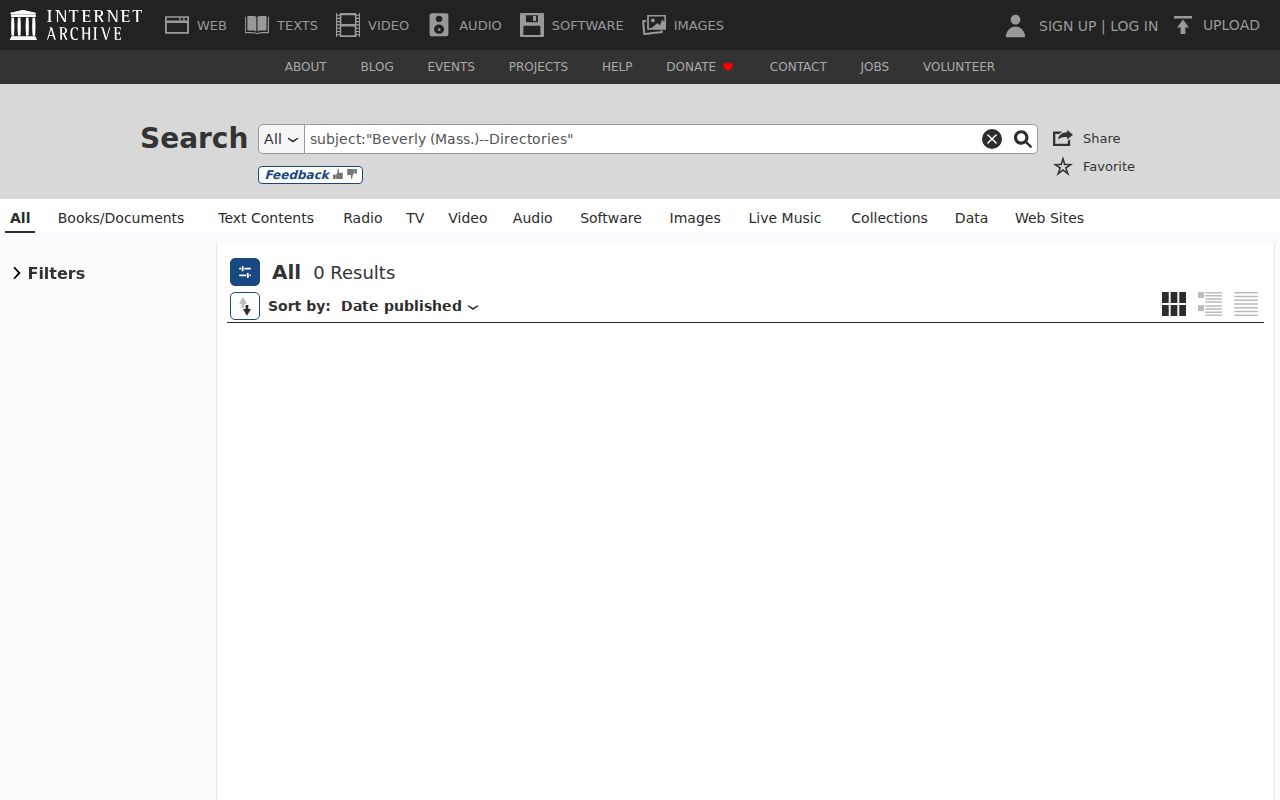
The inspected Internet Archive subject result set contained 76 records, a useful discovery count but not proof that every year or scan is complete.
Beverly Street Lists First
A directory or street list puts a person and address together for a stated date. Copy the address exactly as it appears, including an abbreviated suffix, unit letter, or older place label. Then create a separate search version with the number, street name, suffix, city, ZIP if needed, parcel ID, and source date. This preserves evidence while allowing a search across changing street forms.
Do not assume the listed person owned the address. Directories can group people at one number, omit children or boarders, and carry stale telephone data. An assessed owner is also not proof of occupancy. Keeping separate columns for directory-listed person, street-list appearance, assessed owner, grantor/grantee, mailing address, and source date prevents one historic fact from being turned into another.
Beverly Deed Chain Backward
The Beverly FY2026 Assessments Online portal, delivered through Patriot Properties WebPro, can provide the current assessment-side lead, such as a property or parcel identifier, situs address, and owner field where shown. Note the fiscal year and valuation date. An assessment card is not a title opinion and a mailing address is not proof that someone lives at the parcel. Use it to form a precise Registry search, then read the recorded image rather than relying only on an index row.
- Record the current assessment result’s address, parcel or account identifier where shown, fiscal year, and the source date. Keep its role as assessment evidence.
- Locate the purchaser’s deed in the Southern Essex Registry index. Capture the grantor, grantee, recording date, document type, town, and book/page or instrument number.
- Open the image when available. Compare the legal description, plan citation, and prior-deed reference with the address. A street address alone can change.
- Use the seller as a grantee to find that seller’s earlier purchase, then repeat the same capture steps backward through the recorded trail.
- For an earlier gap, move from the online index to book/page references, Registry materials, library or archival help, and narrowly described record requests. Do not claim a completed title chain from a quick search.
- Grantor / grantee
- The grantor transfers an interest in the recorded instrument. The grantee receives it. Those roles are specific to that document and date.
- Chain of title
- A sequence of recorded ownership-related instruments and references examined over time. It is not established by a single search result.
- Legal description
- The deed’s parcel description, often tied to a plan or prior reference. It is generally more stable than an old street number.
- Criss-cross directory
- An address-ordered directory section that can connect a dated number to a listed household, without proving ownership.
- Enumeration district
- A geographic area used to organize a census. It helps locate a household in the correct census context.
Southern Essex Registry Search
The Southern Essex Registry of Deeds serves Beverly and keeps a Beverly office at 100 Cummings Center, Suite 206-C. Its classic search offers name, street, extended, book/page, and registered-land modes. The current site reported a new search module in April 2026 while retaining the classic route, so document the interface and date used. The Registry’s own warning is important: online information is informational and should not be treated as a title search.
For an address lead, select Beverly, enter the street name without Ln, Ave, Dr, or St, and use the primary number only. Do not use a range or lettered suffix in the number field. The classic street index is described as 1995 forward for deeds and conveyances, so it is an efficient later-period lead rather than a complete historical address index. Name and book/page searches carry the trail earlier.
The portal’s displayed snapshot reported image coverage beginning in 1640 at Book 1, Page 1 and extending through 2026; the name index snapshot begins in 1951 and the registered-land materials begin in 1899. Coverage and result layouts can change, so verify them in the current portal.
Beverly Directories and Census
Owners are only one part of a house history. Dated directories and street lists can identify a listed household, while census schedules can test household composition in the closest census year. Beverly’s directory collection is covered in detail in the Beverly City Directory records. Use that collection as a source of annual-ish snapshots, not as a current resident list.
The observed 1981 OCR demonstrates surname, given or middle name, suffix, household notation, short affiliation, street address, and telephone fields. It also contains an (H) notation whose key was not verified. Preserve the mark in a citation, but do not expand it from guesswork.
The 1981 Beverly directory OCR sample makes the fields and abbreviations visible before a researcher consults the scan.
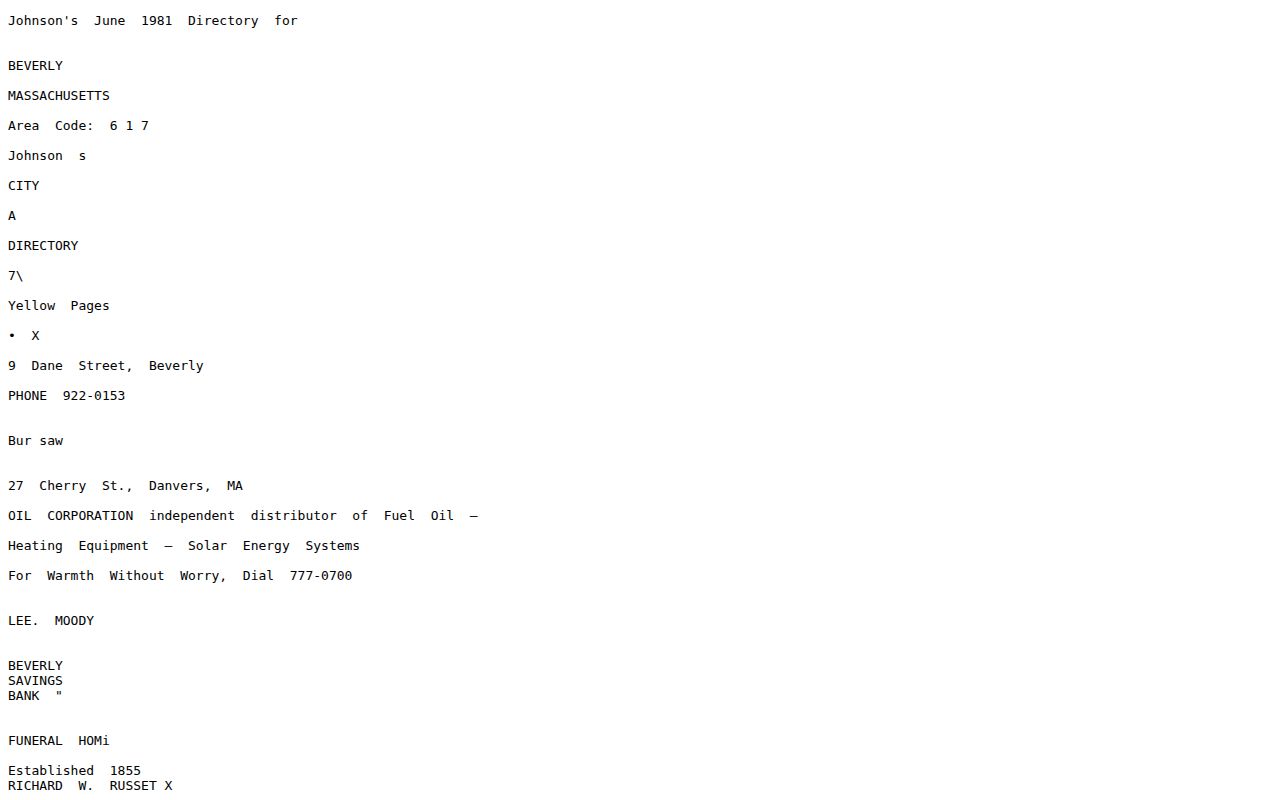
Use the OCR as a finding aid, then check the underlying page because character recognition can misread initials, numbers, and abbreviated streets.
Pair Beverly Household Dates
Pairing sources reduces false matches. A surname that appears at a number in one directory might represent a boarder, a relative, a business address, or a different person with the same name. Use the street and household notation to select the right census context, then retain each source’s different claim.
- Choose a directory or street-list year close to the period of interest and record the original spelling, address, and page or item reference.
- Find the nearest available census year and locate the appropriate enumeration district using the address, nearby streets, and map context.
- Compare names, ages, relationships, and address information without overwriting the directory’s separate date and wording.
- Check the directory years on either side of the census. A move, disappearance, or changed surname should be treated as a question to test, not an automatic life event.
- Add an obituary, cemetery index, or newspaper item only when its date and source provide independent corroboration.
For missing years, Beverly Public Library newspaper microfilm and Historic Beverly research holdings offer useful offline paths. Historic Beverly’s Research Library is at Cabot House, 117 Cabot Street; its published schedule includes Wednesday, Friday, and Saturday daytime hours and Thursday evening hours, with appointments recommended. Its listed research and access fees vary by service, and condition restrictions can apply. Confirm current hours, fees, and database availability before relying on an offline search.
Beverly Maps Date Houses
Maps date the physical setting rather than the household. The Massachusetts State Library lists Beverly Sanborn editions for May 1886, January 1891, March 1896, June 1901, 1907, a 1907 map corrected through June 1950, 1958, 1964, and 1970. The Library of Congress hosts the 1958 set. Compare the historic street number, nearby landmarks, footprint, outbuildings, lot lines, road name, and printed use label across the nearest map years.
Sanborn sheets can show why an address trail breaks: a building changed, a street label shifted, or a lot was divided. They do not identify occupants and should not be used as a legal boundary or title conclusion. Current GIS layers and an assessor parcel ID can help bridge a historic map to the current location, while retaining the map’s own date.
Beverly Boundary Changes Matter
Historic searches must use the place name appropriate to the record year. Massachusetts Historical Commission material records boundary work with Salem and Wenham by 1679, a 1753 annexation from Salem, an 1857 annexation to Danvers, and Beverly’s city incorporation in 1894. A record may therefore name a nearby jurisdiction even when the address is understood as Beverly today.
Keep the original city or town label in a research log and search alternate municipal references where the date calls for it. Also preserve older street spelling, suffix, and number forms. A present-day address normalization is helpful for a search, but it should never erase the original wording of a deed, map, or directory entry.
Beverly Newspapers Test Leads
Digitized Beverly newspapers from 1850 through 1935 can support a move, life event, property sale notice, school activity, organization mention, or obituary search. Search a name with a street, spouse, organization, or date. Preserve the publication title, page, issue date, and the type of item found. An advertisement or announcement is not the same as an official record.
Use a newspaper to form or test a hypothesis, not to prove a deed chain or continuous residency. For a property transfer, return to the Registry image. For a household, return to the dated directory, street list, or census. This separation is especially important where a common surname or changing address creates several plausible matches.
Beverly House History Limits
Previous residents research is appropriate for house history, family history, heirs, and personal curiosity when records are used carefully. Do not use a historical trail to locate, contact, stalk, harass, or harm a living person. Massachusetts has an Address Confidentiality Program, and some RMV, court, health-license, voter, and other records are limited or protected by design.
Lawful personal use. Share the smallest amount of historical detail needed for the question. Keep private phone numbers, full dates of birth, protected addresses, and sensitive relationship claims out of a public summary. M.G.L. c.66 §10 and exemptions in M.G.L. c.4 §7 cl.26 guide Massachusetts public-records access; a narrow request for a dated record is safer than a broad request about a person.
When a portal does not expose a needed historic item, ask the custodian, Registry, library, or archive for a specific year, parcel, street, or book/page reference. Record the URL, search mode, query date, result date, access condition, and a brief reliability note. Those details make the next review reproducible without presenting a partial trail as certainty.